
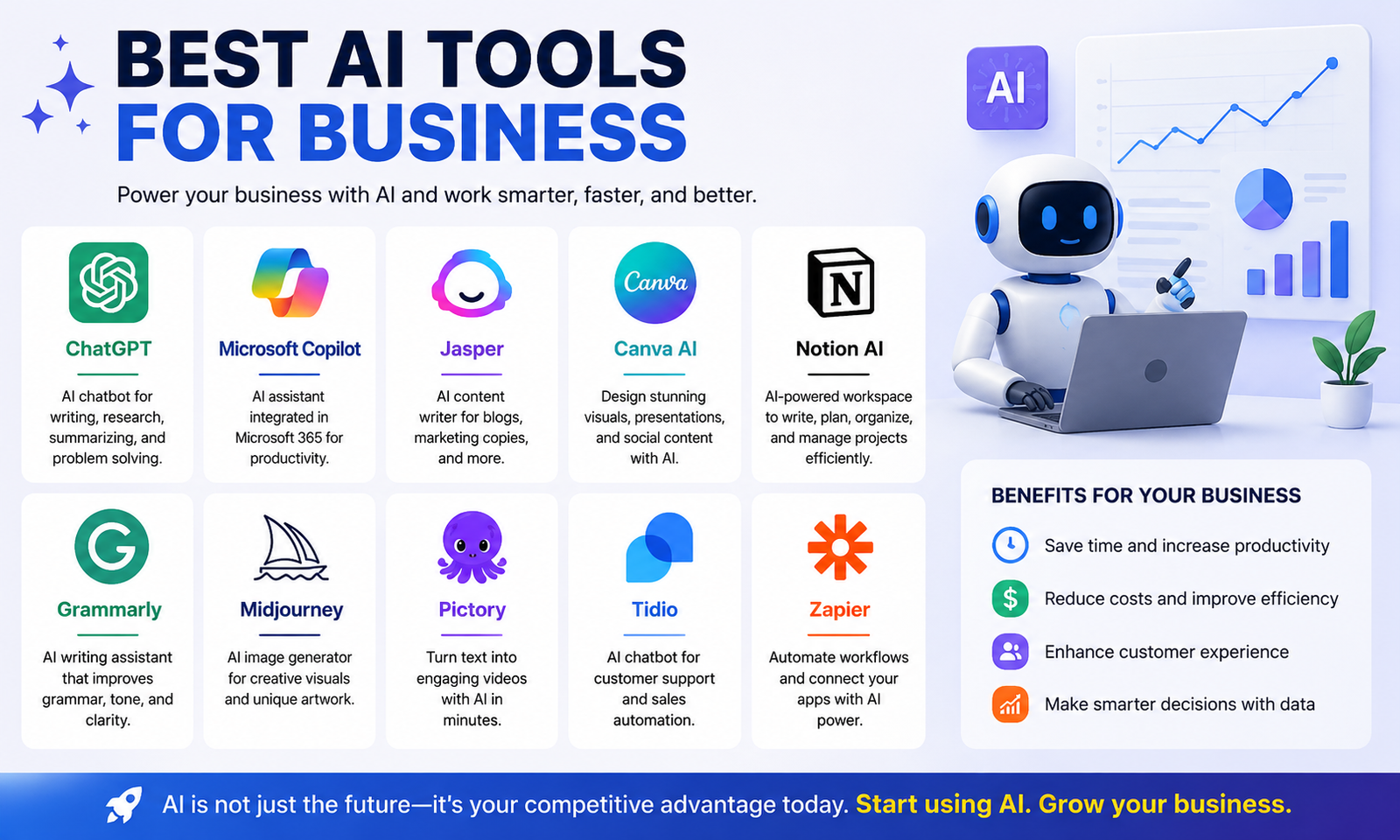
Quick answer: The best AI tools for business in 2026 include Jasper AI and Copy.ai for content creation, Zendesk AI for customer support, AdCreative.ai for ad design, and Zapier AI for workflow automation. Choose tools that offer seamless integration, enterprise-grade data security, and specific features tailored to your daily operations.
Artificial intelligence has officially transitioned from a novelty to a strict operational requirement. Companies are adopting AI tools faster in 2026 because the technology now actively executes complex tasks rather than simply answering basic questions. Modern AI platforms handle everything from managing customer inquiries to designing high-converting advertising campaigns.
Implementing the right AI business software directly impacts your bottom line. Organizations leveraging these systems report significant benefits, including widespread task automation, substantial cost reduction, and massive productivity boosts. AI tools for business also create a much better customer experience by providing instant, personalized support at any hour of the day.
This comprehensive guide covers the top AI software available today. You will learn how to identify the best platforms for your specific needs, discover the top tools across seven distinct business categories, and understand how to avoid common implementation mistakes.
Table of Contents
What features define the best AI software for businesses?
Selecting the right AI business automation tools requires looking beyond flashy marketing claims. The best AI tools share several core characteristics that make them viable for professional use.
- Ease of use: The AI software must have an intuitive interface so non-technical employees can navigate it without extensive training.
- Integration with existing systems: A useful AI platform connects directly to your current tech stack, such as your CRM, email provider, and team messaging apps.
- Pricing and scalability: The cost must align with the return on investment. The AI tool also needs to handle increased workloads as your company grows.
- Security and privacy: Enterprise-grade AI platforms must protect sensitive company data and comply with global privacy regulations like GDPR and SOC 2.
- Customer support and reliability: Vendors must provide dependable uptime and responsive technical support to minimize business disruptions.
- Industry-specific features: The most effective AI applications offer specialized capabilities designed for specific verticals, such as ecommerce inventory forecasting or legal document review.
What are the top AI tools for small business and enterprise growth in 2026?
The market offers hundreds of solutions, but a few platforms consistently outperform the competition. Here is a breakdown of the best AI tools for business categorized by their primary function.
Which AI writing platforms are best for business content creation?
AI writing platforms help marketing agencies, bloggers, and ecommerce brands generate high-quality text at scale. These applications include AI blog writers, social media content generators, and email writing assistants.
Recommended Tools:
- Copy.ai: Copy.ai operates as a comprehensive Go-To-Market (GTM) AI platform. Copy.ai automates repetitive workflows across sales and marketing by codifying best practices into repeatable actions, preventing tool bloat.
- Jasper AI: Jasper AI excels at generating long-form blog content and maintaining a consistent brand voice across large marketing teams.
- ChatGPT: OpenAI’s flagship tool remains a highly versatile option for drafting emails, brainstorming ideas, and creating initial content outlines.
- Grammarly AI: Grammarly AI goes beyond spell-checking by offering structural writing improvements and tone adjustments for professional communications.
What are the top AI customer support tools for automating service?
Customer expectations for rapid responses have never been higher. AI customer support tools manage ticket handling, provide 24/7 customer service automation, and offer multilingual support to assist global audiences.
Recommended Tools:
- Zendesk AI: Zendesk AI analyzes incoming support tickets, categorizes them by urgency, and suggests accurate responses to human agents.
- Intercom AI: Intercom AI utilizes intelligent chatbots to resolve common customer queries instantly without human intervention.
- Tidio AI: Tidio AI provides an accessible chatbot solution tailored specifically for small business websites and ecommerce stores.
- Freshdesk AI: Freshdesk AI helps support teams automate their most repetitive tasks to improve overall response times.
Which AI marketing tools provide the best campaign ROI?
AI marketing tools take the guesswork out of audience targeting and content strategy. These platforms assist with AI SEO optimization, keyword research, ad campaign automation, and advanced data analytics.
Recommended Tools:
- Surfer SEO: Surfer SEO analyzes top-ranking search results to provide data-driven recommendations for optimizing your blog content.
- SEMrush AI: SEMrush AI offers powerful keyword research capabilities and competitive analysis to guide your digital marketing strategy.
- HubSpot AI: HubSpot AI integrates predictive analytics directly into your CRM to help sales teams identify high-value leads.
- AdCreative.ai: AdCreative.ai generates high-performing ad creatives, texts, and product videos. AdCreative.ai trains its models on over $35 billion in ad spend data to predict campaign success before you launch.
What are the best AI design tools for creating business graphics?
Visual content drives engagement across all digital channels. AI design and image generation tools allow teams to create professional logo generations, social media graphics, product mockups, and AI image edits without hiring an entire design department.
Recommended Tools:
- Canva AI: Canva AI simplifies graphic design by allowing users to generate images from text prompts and magically resize assets for different social platforms.
- Adobe Firefly: Adobe Firefly provides commercially safe AI image generation that integrates flawlessly with Photoshop and Illustrator.
- Midjourney: Midjourney generates stunning, highly detailed conceptual art and visual assets based on complex user prompts.
- Leonardo AI: Leonardo AI gives designers granular control over the style and consistency of their AI-generated visual assets.
Which AI video editing software is best for short-form content?
Video marketing dominates social media algorithms. AI video editing tools automate video creation, generate automatic subtitles, provide AI avatars with realistic voiceovers, and streamline short-form content generation.
Recommended Tools:
- Synthesia: Synthesia allows businesses to create professional training and marketing videos using lifelike AI avatars and text-to-speech technology.
- Pictory: Pictory automatically transforms long-form blog posts and articles into engaging short videos complete with stock footage and captions.
- Runway ML: Runway ML offers advanced generative video capabilities, allowing creators to alter video styles or generate new video clips from text.
- CapCut AI: CapCut AI provides mobile-friendly editing tools that use AI to automatically cut dead space and add trending effects to social media clips.
What are the top AI automation tools for team productivity?
Efficiency is the ultimate competitive advantage. AI productivity and automation tools handle background workflow automation, provide AI scheduling assistants, improve team collaboration, and streamline task management.
Recommended Tools:
- Zapier AI: Zapier AI connects thousands of different software applications, allowing users to build complex automated workflows using simple natural language prompts.
- Notion AI: Notion AI acts as an intelligent workspace assistant that summarizes meeting notes, extracts action items, and drafts project outlines.
- ClickUp AI: ClickUp AI accelerates project management by automatically generating task descriptions and providing status updates to stakeholders.
- Microsoft Copilot: Microsoft Copilot embeds AI directly into Word, Excel, and PowerPoint to help corporate teams process information and draft documents faster.
Which AI ecommerce tools help increase online sales?
Online retailers use AI to drive conversions and manage logistics. AI tools for ecommerce businesses handle product description generation, surface AI product recommendations, execute AI inventory forecasting, and deliver customer personalization.
Recommended Tools:
- Shopify Magic: Shopify Magic helps merchants write compelling product descriptions and manage store data directly within the Shopify dashboard.
- Klaviyo AI: Klaviyo AI analyzes customer shopping behavior to send highly personalized, automated email and SMS marketing campaigns.
- Jasper AI: Jasper AI helps ecommerce teams scale their catalog by rapidly generating hundreds of SEO-optimized product listings.
- Prisync: Prisync uses AI to track competitor pricing and automatically adjust your store’s prices to maximize profit margins.
What is the best way to evaluate AI software for your company?
Choosing the right AI platform requires a strategic approach to ensure a high return on investment. Start by clearly defining your business goals. Choose AdCreative.ai if your priority is scaling ad campaigns and improving return on ad spend, but opt for Copy.ai if you need to unify your entire go-to-market strategy across sales and marketing.
Always start with one specific problem first rather than trying to overhaul your entire company at once. Compare free vs. paid tools to understand what features you truly need. Next, check integrations to confirm the AI software communicates with your existing databases. Finally, run a small test program with a single team before scaling the software company-wide.
What common mistakes should businesses avoid when implementing AI?
Businesses often stumble when adopting new technology. The most dangerous mistake is depending fully on AI without human review. AI models can hallucinate or produce off-brand messaging, making human oversight mandatory for quality control.
Another critical error is ignoring data privacy. Feeding confidential company information or customer data into public AI models exposes your business to severe security risks. Companies also struggle by using too many tools at once, which creates workflow bottlenecks and subscription fatigue. Finally, choosing tools without conducting an ROI analysis often leads to wasted budget on software that fails to solve real problems.
How will AI technology impact businesses in 2027 and beyond?
The future of AI points directly toward autonomous action. We will see a massive rise in AI agents that can independently execute multi-step workflows without human prompting. This shift will enable hyper-personalized marketing, where platforms generate unique ad creatives and copy for individual consumers in real time.
AI-powered decision-making will also become standard practice for leadership teams. Executives will rely on AI to analyze market trends and forecast financial outcomes. As we look toward 2027, growth predictions indicate that businesses utilizing AI will significantly outpace competitors who rely solely on manual processes.
How to start automating your workflow with AI software today
AI is becoming an essential utility for modern organizations. Both small businesses and massive enterprises can harness top AI software in 2026 to reduce costs, increase output, and improve customer satisfaction.
The key to success is starting simple and scaling gradually. Identify one manual task that drains your team’s time, select a recommended AI tool from this guide, and run a pilot test. Encourage your team to explore these AI tools today so your business can maintain its competitive edge tomorrow.
FAQs
What is the best AI tool for small businesses?
The best AI tool for a small business depends on the specific bottleneck the business faces. Canva AI is the best tool for affordable graphic design, Zapier AI is the best choice for automating administrative workflows, and Tidio AI is the top option for handling basic customer support inquiries.
Are AI tools expensive?
AI software pricing varies widely based on usage limits and feature sets. Many powerful tools offer free tiers or low-cost monthly subscriptions starting around $20 per month. Enterprise-grade AI platforms with custom security protocols and dedicated support typically cost several hundred to several thousand dollars monthly.
Can AI replace employees?
AI is currently designed to augment human workers rather than replace them entirely. AI business tools automate repetitive, low-level tasks, which frees up human employees to focus on complex strategy, creative direction, and relationship building.
Which AI tool is best for marketing?
AdCreative.ai is the best AI tool for generating high-converting digital advertisements and product videos. For content marketing and overarching go-to-market strategies, Copy.ai serves as the top AI marketing platform for unifying messaging across teams.
Is AI safe for business use?
AI is safe for business use when companies choose secure, enterprise-grade platforms that comply with data privacy laws. Businesses must establish clear internal guidelines that prohibit employees from sharing sensitive corporate data or customer information with public, open-source AI models.
